
A real cowhide rug costs three to four times what a faux one does, and no listing explains why or whether the gap is worth it. Then there is the question people actually type into search at midnight: is buying one cruel? This article answers both, with prices pulled in July 2026, a lifespan-based cost calculation nobody else runs, and a verdict I am willing to put my name on.
The Quick Answer
Real cowhide wins on longevity, texture, and one-of-a-kind pattern, and because hides are byproducts of the beef industry, the ethical picture is more nuanced than it first appears. Faux wins on upfront price and suits vegan households and kids’ rooms. Run the numbers per year of use and the two are nearly tied, which means the real decision is about values and feel, not money. The full math is below.
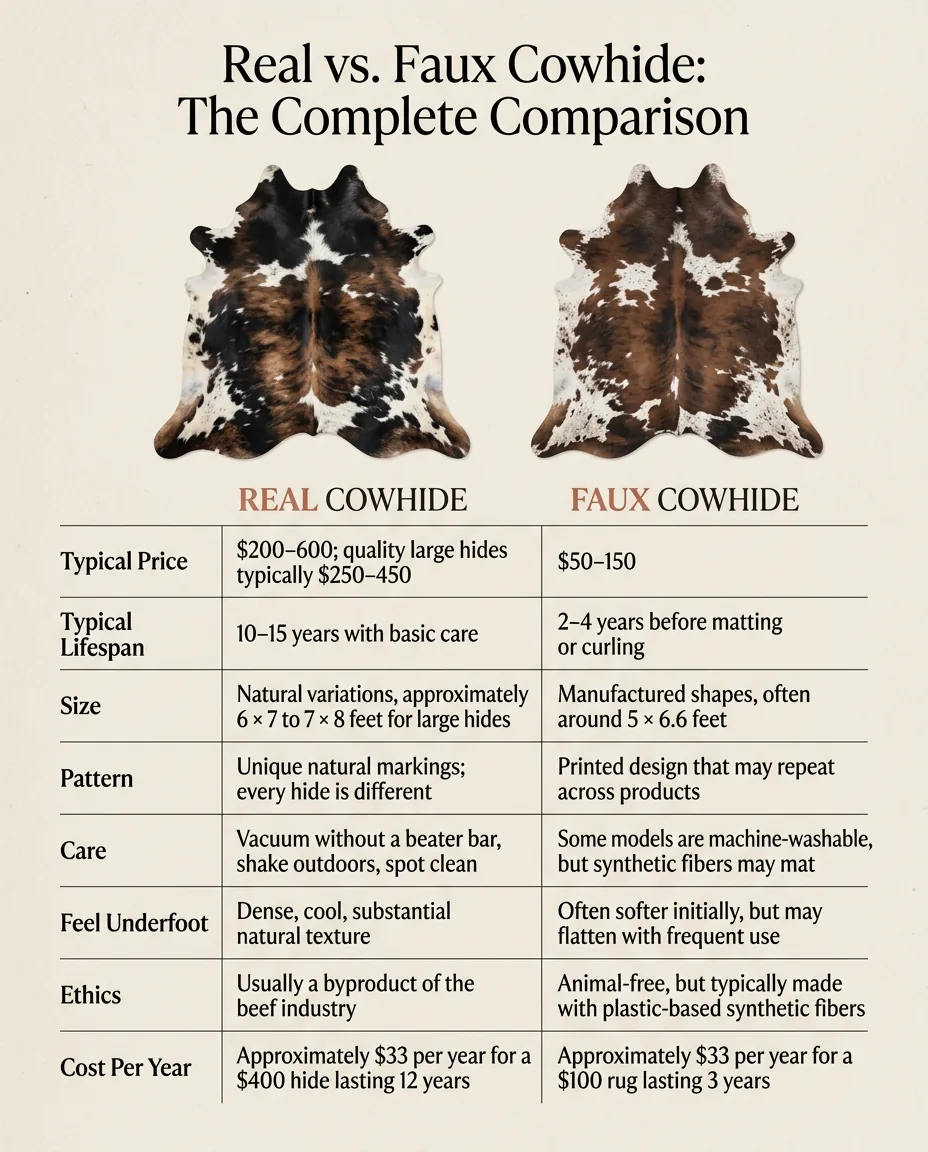
Real vs Faux: The Full Comparison
| Real cowhide | Faux hide | |
|---|---|---|
| Typical price | $200–600 (most quality large hides $250–450) | $50–150 |
| Typical lifespan | 10–15 years with basic care | 2–4 years before matting or curling |
| Size | Natural, roughly 6x7 to 7x8 ft for large | Cut shapes, usually 5x6.6 ft |
| Pattern | One of a kind, literally | Printed, repeats across units |
| Care | Vacuum (no beater bar), shake out, spot clean | Machine-washable in some cases, but fibers mat |
| Feel underfoot | Dense, cool, substantial | Softer at first, flattens with traffic |
| Ethics | Byproduct of the beef industry | No animal, but synthetic (plastic-based) fibers |
| Cost per year | About $33 ($400 over 12 years) | About $33 ($100 over 3 years) |
Read that last line twice. The four-times price gap disappears when you divide by years of service. Around $33 a year either way, checked against typical July 2026 retail. So the money argument is a wash, and the decision moves to everything else in the table.
Real Cowhide
What You’re Paying For
Quality hides, most of them Brazilian, are chromed and tanned to stay supple for a decade or more. The price spread inside the real category is about size, dye work, and finish: a natural salt-and-pepper or brindle large hide typically runs $250 to $450 at retailers like Rugs USA and eSaleRugs, while oversized, metallic, or specialty-dyed hides push toward $600. Under $200 for a “real” large hide is the flag to slow down; thin, brittle hides exist and they crack within a couple of years.
Sourcing and the Ethics Question
Here is the honest version. Hides are byproducts of the beef industry: the animal is not raised for the rug, and industry groups like the Leather and Hide Council of America note that hides would otherwise largely go to waste. That is materially different from fur. It does not make the purchase vegan, and if no animal involvement is your line, faux is your answer and a legitimate one. But “cowhide rugs are cruel” as a blanket claim does not survive contact with how the supply chain actually works. Buy from a retailer that states origin, and you are buying a durable use for a byproduct.
Care
Less than you think. Vacuum with suction only, no beater bar. Shake it outside once a month. Spot clean with a barely damp cloth and mild soap, wiping with the hair. Never steam it, never machine-wash it, and rotate it a quarter turn every few months so traffic wears evenly. Quality hides shed lightly in the first weeks, then settle.
Faux Hide
When Faux Makes Sense
Three cases where I would choose faux without hesitation: a vegan household, a kid or pet zone where spills are a weekly event and machine-washing matters, and a rental you will leave in a year. At $50 to $150 from Target, Wayfair, and Rugs USA’s faux lines, the entry cost is genuinely low, and the good ones look convincing from standing height for their first year or two.
The Good Ones vs the Shiny Ones
The tell is sheen. Quality faux hides use a matte, dense, slightly varied pile that mimics hair direction. The bad ones shine like a stuffed animal under any lamp and photograph even worse. In the store, drag your palm across the pile against the grain: if it flattens and holds the handprint, it will mat in months. Spend at the top of the faux range ($100 to $150) or do not bother; the $50 tier is a one-season purchase.
Sizing and Placement
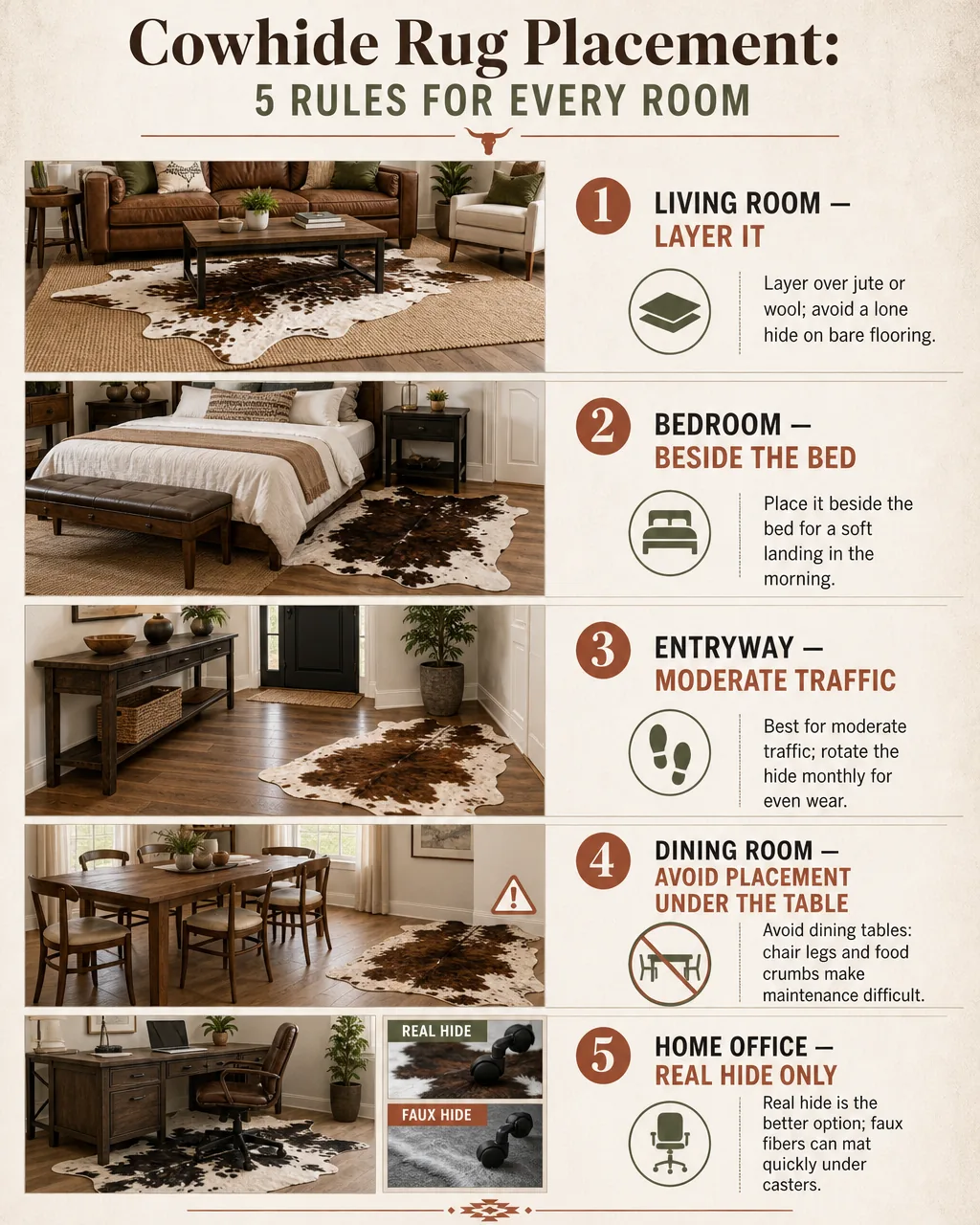
- Living room: layer the hide at an angle over a jute or wool base rug, front third under the coffee table. The layering is the whole look; a lone hide floating on bare floor reads sparse.
- Bedroom: off one side of the bed, angled, so bare feet land on it in the morning.
- Entryway: works if traffic is moderate; rotate it monthly.
- Under a dining table: no. Chair legs and crumbs defeat both real and faux.
- Office: under a desk chair only with a real hide; faux mats under casters within weeks.
A large natural hide covers roughly 6x7 feet at its widest points, but the organic shape means it visually occupies less than a rectangle of that size. When in doubt, size up.
My Pick (and Why)
Real, in natural salt-and-pepper, layered over jute, from the $250 to $450 middle of the market. The cost-per-year math removed the price objection for me, and what remains all points one way: a pattern no one else owns, a texture that improves instead of degrading, and a byproduct put to a fifteen-year use. I would go faux in exactly the three cases named above, and otherwise I would not.
The one thing I would never buy is the $60 “real” hide from an unnamed source. In this category, suspiciously cheap means thin, and thin means cracked by year two, which is the worst of both worlds.
FAQ
Are cowhide rugs cruel?
Cowhide rugs are byproducts of the beef industry; cattle are not raised for hides, and the leather industry notes these hides would otherwise largely be discarded. That makes them a different ethical case from fur. They are not vegan, so if animal involvement is your line, quality faux is the honest alternative.
Do cowhide rugs shed?
Quality real hides shed lightly during the first few weeks, then settle to almost nothing with regular suction-only vacuuming. Persistent heavy shedding signals a thin, poorly tanned hide, which is the main risk of the under-$200 “real” tier. Faux hides do not shed but mat down with traffic instead.
How long does a cowhide rug last?
A quality real cowhide lasts 10 to 15 years with basic care: suction vacuuming, occasional shake-outs, and rotation. Faux hides typically look good for 2 to 4 years before the pile mats or edges curl. Divided by lifespan, both end up costing roughly $33 per year of use.
Can you vacuum a cowhide rug?
Yes, and you should, weekly in traffic areas, using suction only with the beater bar off and moving in the direction of the hair. Shake it outdoors monthly. Skip steam cleaners and washing machines entirely for real hides; both damage the tanning and cause curling.
Buy Once, Buy the Middle
The comparison collapses to one sentence: pay $250 to $450 once for a real hide, or pay $100 to $150 for the best faux and plan to repeat it. Both are defensible; only one gets better with age. Where it goes next is the fun part: a cowhide is the floor anchor of the whole look in ranch style living room ideas, and it plays beautifully under the textiles in layering Pendleton-style blankets.

Prices in this guide were checked at publication and are shown as typical ranges. How we check facts and prices →